DS 3: Practical information / Bonnet
 Stop
& Start
Stop
& Start
Before doing anything under the bonnet, you must switch off the ignition to avoid any risk of injury resulting from an automatic change to START mode.

 The
location of the interior bonnet release
lever prevents the bonnet being opened
when the left-hand front door is closed.
The
location of the interior bonnet release
lever prevents the bonnet being opened
when the left-hand front door is closed.
 When
the engine is hot, handle the
exterior safety catch and the bonnet stay
with care (risk of burns), using the protected
area.
When
the engine is hot, handle the
exterior safety catch and the bonnet stay
with care (risk of burns), using the protected
area.
When the bonnet is open, take care not to damage the safety catch.
Do not open the bonnet under very windy conditions.
 Cooling of the engine
when stopped
The engine cooling fan may start after the
engine has been switched off.
Cooling of the engine
when stopped
The engine cooling fan may start after the
engine has been switched off.
Take care with objects or clothing that could be caught in the blades of the fan!
Opening
- Open the left-hand front door.
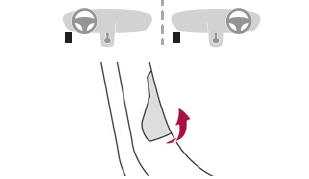
- Pull the interior release lever, located at the bottom of the door frame, towards you.
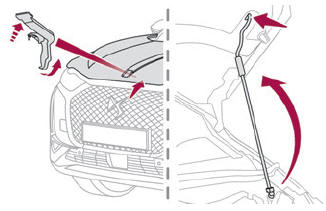
- Lift the exterior safety catch and raise the bonnet.
- Unclip the stay from its housing and place it in the support slot to hold the bonnet open.
Closing
- Hold the bonnet and pull out the stay from the support slot.
- Clip the stay in its housing.
- Lower the bonnet and release it near the end of its travel.
- Pull on the bonnet to check that it is locked correctly.
 Because of the presence of electrical
equipment under the bonnet, it is
recommended that exposure to water (rain,
washing, etc.) be limited.
Because of the presence of electrical
equipment under the bonnet, it is
recommended that exposure to water (rain,
washing, etc.) be limited.
 Energy economy mode. Load reduction mode
Energy economy mode
This system manages the duration of use of
certain functions, in order to conserve a sufficient
level of charge in the battery with the ignition off...
 Engine compartment
The engine shown here is an example for
illustrative purposes only.
The locations of the following components may
vary:
Air filter.
Engine oil dipstick...
Other information:
DS 3 2016-2026 Owners Manual: Steering wheel adjustment
When stationary, pull the control to release the steering wheel. Adjust the height and reach to suit your driving position. Push the control to lock the steering wheel. For safety reasons, these adjustments must only be carried out with the vehicle stationary...
DS 3 2016-2026 Owners Manual: Retractable handles
The doors are equipped with handles that unfold and retract automatically depending on the vehicle state: When unlocking the vehicle, the handles unfold to allow access to the vehicle. When the vehicle is locked, the handles retract. It is possible to manually unfold the handles at any time by pressing on them...
Categories
- Manuals Home
- 1st Generation DS 3 Owners Manual
- 1st Generation DS 3 Service Manual
- ISOFIX child seats
- Steering wheel adjustment
- Service indicator
- New on site
- Most important about car
Digital instrument panel
This digital instrument panel can be customised. Depending on the display mode selected, certain information is hidden or presented differently.