DS 3: Safety / ISOFIX child seats
"ISOFIX" mountings
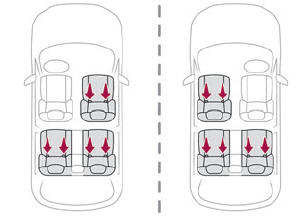
The seats shown below are fitted with ISOFIX compliant mountings:
The mountings comprise three rings for each seat, indicated by a marking:
- Two rings A, located between the vehicle seat backrest and cushion.
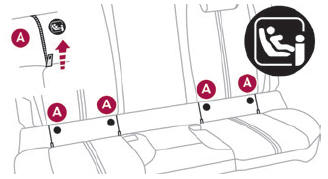
The 2 latches on ISOFIX child seats are secured to them.
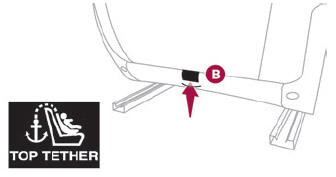
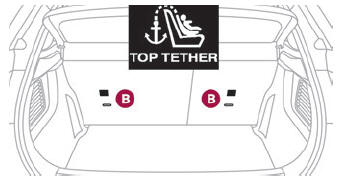
- One ring B, located behind the seat, called the TOP TETHER, for attaching seats fitted with an upper strap.
Front seat
Rear seats
This system prevents the child seat from tipping forwards in the event of a front impact.
This ISOFIX mounting system provides fast, reliable and safe fitting of the child seat in the vehicle.
To secure the child seat to the TOP TETHER:
- Remove and stow the head restraint before installing the child seat on this seat (refit it once the child seat has been removed).
- Pass the strap of the child seat behind the seat backrest, centring it between the openings for the head restraint rods.
- Secure the upper strap hook to ring B.
- Tighten the upper strap.
 When fitting an ISOFIX
child seat to the
left-hand rear seat of the bench seat,
before fitting the seat, first move the centre
rear seat belt towards the middle of the
vehicle, so as to avoid the seat interfering with
the operation of the seat belt.
When fitting an ISOFIX
child seat to the
left-hand rear seat of the bench seat,
before fitting the seat, first move the centre
rear seat belt towards the middle of the
vehicle, so as to avoid the seat interfering with
the operation of the seat belt.
 An incorrectly installed
child seat in a
vehicle compromises the child's safety in
the event of an accident.
An incorrectly installed
child seat in a
vehicle compromises the child's safety in
the event of an accident.
Strictly observe the fitting instructions provided in the user guide supplied with the child seat.
 For information about the
options for
fitting ISOFIX child seats in your vehicle,
refer to the summary table.
For information about the
options for
fitting ISOFIX child seats in your vehicle,
refer to the summary table.
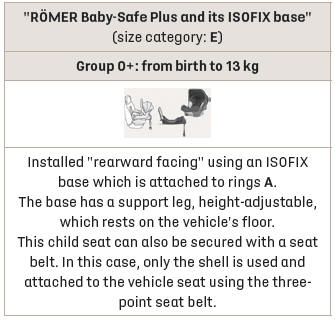
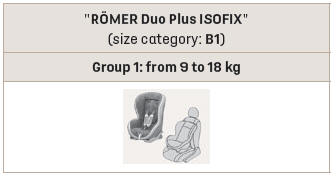
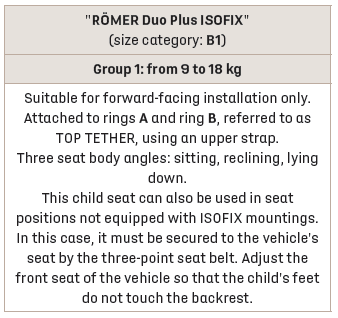
Recommended ISOFIX child seats
 Also consult the user
guide from the child
seat’s manufacturer to find out how to
install and remove the seat.
Also consult the user
guide from the child
seat’s manufacturer to find out how to
install and remove the seat.

 i-Size child seats. Installing child seats
i-Size child seats
i-Size child seats have two latches that are anchored to the two rings A.
These i-Size child seats also have:
either an upper strap that is attached to ring B...
Other information:
DS 3 2016-2026 Owners Manual: Advice
Using the ventilation and air conditioning system To ensure that air is distributed evenly, keep the external air intake grilles at the base of the windscreen, the nozzles, the vents, the air outlets and the air extractor in the boot free from obstructions...
DS 3 2016-2026 Owners Manual: Operating limits. Malfunctions
Operating limits The system may suggest an inappropriate parking space (parking prohibited, work in progress with damaged road surface, location alongside a ditch, etc.). The system may indicate that a space has been found but will not offer it because of a fixed obstacle on the opposite side of the manoeuvre, which would not allow the vehicle to follow a trajectory required for p..
Categories
- Manuals Home
- 1st Generation DS 3 Owners Manual
- 1st Generation DS 3 Service Manual
- Trip computer
- Boot
- Alarm
- New on site
- Most important about car
Electric motor